
Trump paid an effective tax rate of 24 per cent and saved millions of dollars in additional taxes by claiming the losses, according to the document, the first two pages of which were obtained by Pulitzer Prize-winning journalist David Cay Johnston and first shared on "The Rachel Maddow Show.

Chaos in Parliament threw a spanner in the government's efforts to revive the economy and kick-start reforms.

FDI is a major driver of economic growth and a source of non-debt finance for the economic development of the country. The government has put in place an investor-friendly policy on FDI, under which investment up to 100 per cent is permitted on the automatic route in most sectors/ activities. At $ 64.37 billion, FDI in 2018-19 is the highest ever investment received for any financial year.

Finance Minister Nirmala Sitharaman on Monday assured the industry that momentum of economic reforms will continue to make India a hotspot of global investment. India has turned the crisis created by COVID-19 pandemic into an opportunity to push the economic reforms, which remained pending for decades, she said while addressing the National MNC's Conference 2020 organised by industry chamber CII.

They also stressed the need to increase allocation for improving the quality of education and improving infrastructure in rural areas.
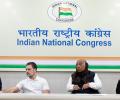
The principal opposition party though appeared content securing 99 of the 543 seats in the 2024 national elections as against its all-time low of 44 in 2014 and then 52 in 2019.
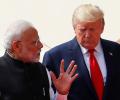
'While criticising India's high tariffs, Mr Trump stated he would impose reciprocal taxes on Indian products if re-elected.' 'However, since India's tariffs follow WTO rules, Mr Trump's actions would violate these rules,' Ajay Srivastava points out.

But their trajectory and direction have been largely influenced by politics and the political leadership's understanding of how the economy needs to be managed, explains A K Bhattacharya.

'If we don't want to be the poorest large economy even in 2030, we need to be doing very much more than is being attempted.'
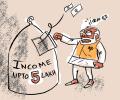
Policymakers are examining the possibility of increasing the tax-free slab to Rs 5 lakh in the two-year-old alternative personal income tax regime to make it attractive, a government official said. At present, taxpayers don't pay income tax if their taxable income is Rs 2.5 lakh and below. Increasing the threshold will reduce the tax outgo for assessees, thereby leaving more money with them to invest, the official said.
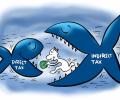
Before 2019, an estimated 22 million individual income-tax returns did not have to pay any taxes. But after the change in the exemption level, another 13 million individual tax returns did not require to pay taxes. Thus, of about 58 million returns, as much as 63 per cent or 35 million went out of the direct tax net, A K Bhattacharya points out.
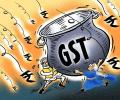
Economic Advisory Council to the Prime Minister (EAC-PM) chairman Bibek Debroy on Tuesday said the government was losing revenue due to the GST, which should be revenue neutral with a single rate. Speaking at an event organised by the Calcutta Chamber of Commerce in Kolkata, he however said that GST has led to a lot of simplification. "The ideal GST is one that has a single rate, and it was meant to be revenue neutral.
"In rural India, even minimal infrastructural facilities are not available for farmers. It is unthinkable to impose a tax on agricultural income, says Rajnath Singh

IMF, which has also lowered its global economic growth forecast for 2016 and 2017 by a marginal 0.1 per cent to 3.1 and 3.4 per cent respectively, recommended six 'reform priorities' for India

Foreign investors continued their relentless selling in the Indian equity markets in August, offloading shares worth Rs 21,201 crore due to the unwinding of the yen carry trade, recession fears in the US and ongoing geopolitical conflicts. This came after an inflow of Rs 32,365 crore in July and Rs 26,565 crore in June, data with the depositories showed.
India will probably unveil bold reforms in its budget on Thursday in a bid to turn around an economy growing at decade lows.
If the concerns over risking political capital are overcome, the long-term gains for the Indian economy will be immense, asserts A K Bhattacharya.

Kailash Gahlot, a key minister in the Aam Aadmi Party (AAP) government in Delhi, has resigned, potentially impacting the party's ambitious plan to roll out a Rs 1000 monthly honorarium scheme for women ahead of the Assembly polls in February. Gahlot, who represented the Jat-dominated Najafgarh constituency in West Delhi, cited several issues, including the "Sheeshmahal" controversy over his former official residence, the Delhi government's tussle with the Centre, and the failure to clean the Yamuna River, in his resignation letter. Delhi BJP leaders welcomed Gahlot's resignation, fueling speculation that he could join the party before the assembly polls. However, AAP leaders claimed Gahlot resigned due to pressure from central agencies, including the Enforcement Directorate, and that joining the BJP was his last option. Gahlot's resignation has sparked speculation about his future and the impact it will have on the AAP's electoral prospects.
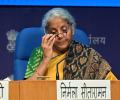
Finance Minister Nirmala Sitharaman is likely to hold pre-budget consultations with industry chambers on June 20, sources said. The budget for 2024-25 fiscal is likely to be presented in Parliament in the second half of July. Industry sources said the pre-budget consultation with Sitharaman would be preceded by a meeting with Revenue Secretary Sanjay Malhotra on June 18.

Majority expect economy to slow down, but are satisfied with Modi govt's performance.

Justice Sanjiv Khanna, who has been part of several landmark Supreme Court judgements such as scrapping the electoral bonds scheme and upholding abrogation of Article 370, will be sworn in as the 51st Chief Justice of India on Monday.
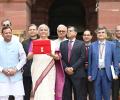
With the reality of coalition politics staring the BJP in its face, this was inevitable, points out Ramesh Menon.

It proposes to bring down the corporate tax from the current 35 per cent to 15 per cent, significantly lower individual tax rates, and eliminate several tax rates like the death tax.

US IT industry has opposed Obama's move to tax overseas earnings.

International Monetary Fund (IMF) Deputy Managing Director (MD) Gita Gopinath has condemned the "terrible and disturbing" incident of rape and murder of a trainee doctor in Kolkata. "Personally, it is terrible to have any event of this kind. It is disturbing," she told Business Standard in New Delhi.

Modi's reform agenda suffered a major setback earlier this month when lawmakers in the Rajya Sabha refused to support the the Goods and Service Tax bill.

'The private sector believes that some enablers in labour-intensive sectors like apparel, toys, tourism, and media retail, can unlock a lot of jobs.'

A tax reforms panel, headed by finance minister's advisor Parthasarathi Shome, is considering moving away from setting fixed tax-collection targets and linking these with the changing economic scenario during the year.
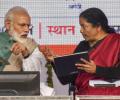
Between August and September Finance Minister Nirmala Sitharaman toured the length and breadth of India meeting traders, experts and entrepreneurs to gauge the pulse of the nation, reports Ruchika Chitravanshi.

"GST should not become a 'grossly scary tax'. It should be a 'good and simple tax'," Surjewala said.

India Inc on Thursday pitched for lowering income tax burden on common man, increase in capital expenditure, and firm steps to contain food inflation in their nearly two-hour long interaction with finance minister Nirmala Shitharaman ahead of the Union Budget. During pre-Budget consultation with Sitharaman, the industry leaders and associations also urged the government to focus more on infrastructure development with a view to maintaining the economic growth momentum. The industry leaders also laid stress on boosting the MSME (micro, small, and medium enterprises) sector, considered a backbone of the Indian economy and main employment generator.

Here are some goods that will be expensive after GST's implementation.
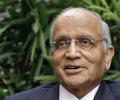
The regulatory burden is the highest on small cars, a key segment of the Indian automobile industry and having a uniform tax structure across all segments of vehicles will not augur well for the sector growth, according to Maruti Suzuki India chairman RC Bhargava. He also said India's economic growth rate could be higher if the manufacturing sector grows fast, which 'unfortunately' has remained a laggard despite the best efforts of the Narendra Modi-led government at the Centre due to implementation gaps at the ground level. "The burden of regulatory changes on the small cars is far higher than the regulatory burden on big cars and that is changing the whole market behaviour.
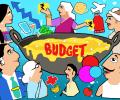
'We have essentially tried to set out an agenda for the next five years and it, in essence, represents the political commitment to that agenda.'

Indian IT companies like Tata Consultancy Services, Infosys, HCL Technologies and others have taken the buyback route to return some wealth to their shareholders, while potentially boosting their stock prices.

Besides Vodafone, several other major MNCs like Nokia and Shell were locked in tax dispute with the revenue department.

'Investors looking at the next 6-12 months can be certain that the Fed will maintain its easing cycle, and we expect the overall environment to be conducive for fixed income investments for portfolio diversification.'

All pre-election opinion polls indicate a strong majority for the Opposition Labour Party, forcing the incumbent Sunak-led Conservatives on the back foot to caution voters against handing a "supermajority" to the Keir Starmer-led Labour.

'I found it unbelievable that L&T said 45,000 jobs were waiting to be filled because of unavailability of suitable skillsets.' 'So, when the Opposition sweepingly says there are no jobs, I'm sorry... I'm not saying it's raining jobs, but there are jobs. The (skill) gap has to be bridged.'
 © 2026 Rediff.com - Advertise with us - Disclaimer - Privacy Policy - Sitemap - Feedback - About us - Terms of use - Grievances